Wednesday, 11 September 2013

Conservatives Win the Norwegian Election!

After 8 years of running the show, Jens Stoltenberg, the Labour PM, will hand over the reins of government to Erna Solberg, the leader of the Høyre party. (That translates as "Right," and is often referred to here as the Conservative party. The party's positions, however, are nowhere close to those of America's Republican party; they are more comparable to those of the Democrats, according to one Norwegian we spoke with.)

The run-up to the election was easy to ignore, unlike election campaigns in the USA. A week or two prior to the vote (for which all public schools were closed), posters began appearing on the buses and trams on the streets. One day, on the walk to school, we encountered a few young adults who were passing out literature. Here are examples of typical posters. Those of the parties on the right (yes, there are multiple parties on the right and the left, as Norway has a parliamentary system of government), could be easily taken, especially by those of us who have a minimal grasp of the language, for corporate ads.

Here's Erna: She'll be the second female PM in Norway's history (something that would draw lots of comment in the States but hasn't been talked about too much here). Her poster says: "Because Norway needs New ideas and better solutions!


Here's Jens: He got a lot of credit for his calm manner after the hideous shooting incident here two years ago, when Anders Breivik murdered over 70 Labour party youths at a summer camp. But subsequent investigations of the emergency response were critical and political opponents used this to criticize Stoltenberg. His poster says "We are ready to fight for what we believe in"; "The best school for ALL v. the best school for the few"; "The future of Norway is being decided now"; and something to the effect of "We will take Norway further with everyone together."


Labour is preferred by many Norwegian men, and the party actually won a plurality of the vote with 31%. But that is short of what was needed to form a government. In the past election, Labour teamed up with two other parties to create a governing coalition, but this time out, the addition of those parties added up to only 72 seats in parliament, well behind the 96 that Høyre, in combination with three other so-called center-right parties, got. (Labour outpolled Høyre by almost 4%.) 

Here's a poster for one of the parties Høyre will need to work with--the KrF (short for Kristelig Folkeparti or Christian-Democrats). We saw several different posters featuring party leader Knut Arild Hareide, whom I found unappealing. The heart motif also struck me as treacly and corny. The poster says "The family knows best" and goes on to promise that the Christian-Dems will "give the family greater choice through flexible parental leave until the child is ten years old" and "increased steady support." (I do like a couple of their positions: removing taxes on fruit and veggies, and making sure everyone who gets permanent residency status receives a "welcome package.")


Basically, all the parties can offer people pretty much anything, including increased expenditures AND lower taxes, because Norway is so incredibly rich. The riches are from oil, the profits from which have been put into a fund that now totals something like three-quarters of a trillion dollars. There are apparently some disagreements among the parties are over how much of the interest from this fund can be spent yearly; spending is currently capped at 4%. The Fremskrittspartiet (FrP)--referred to commonly in English-language news stories as the Progress Party--has favored raising the limit. But that party is much more notable for its position on immigration. They don't favor it, or I should say, they oppose it when the immigrants are from nonwestern countries. Sound familiar?

It is the misnamed Progress Party, led by a bruiser of a gal, Siv Jensen, that has, after 40 years in existence, finally been invited into a governing coalition (with Høyre). The FrP actually LOST votes in contrast to the last election when it garnered something like 25%. The loss of support is attributed largely to the party having been tainted, in some voters' minds, by the discovery that the gunman Breivik had once been a member of FrP, and that some of Breivik's writings echoed the ideas that a FrP member had advanced. (Breivik dropped out of the party because he felt it was not extreme enough.)

Here's a photo of Siv Jensen. Not sure when this dates from. It captures her determination but not her charisma, such as it is. I saw her interviewed on NRK (Norway's BBC); she'd chosen to be filmed working out at a gym with a personal trainer. My Norwegian is quite limited but she seemed to be saying something about the importance of a strong body for a strong mind.


For Høyre and the Progress Party to form a government, they will still need participation from at least one other right-leaning party, and perhaps two. Both of those parties--the Christian Dems and the Liberal Party (not "liberal" in Americans use of the term, but "liberal" in the traditional meaning, as in everyone is a free actor in the marketplace)--said prior to the election that they would not form a coalition if it included FrP, because of FrP's stance on immigration. 

Immigration--it is the thorny issue that Norway is are grappling with. Apparently, the majority of the immigrants ARE from other European countries. But they are less noticeable here in the land, traditionally, of the blond and blue-eyed. Siv Jensen believes that the Somalis are a big problem, that they are moochers who will not get jobs. (She says that the Somalis in America have shown entrepreneurial initiative, so it is not innate to Somalis to be lazy; it is the generous welfare in Norway that has made them so.) The rhetoric is taking me back to the early Reagan presidency. Ah, nostalgia. Siv's role model, she says, is Maggie Thatcher. 

SJ is also quite unhappy about Muslims generally, arguing that Norway is a secular nation with a separation of Church and State and has no place for Muslims who want to practice Islam. Now that the election is over, perhaps Siv will have the time to take a tour of the Royal Palace, where the guide will explain that the King is both the head of the Norwegian government and the head of the Church.)

Not to make light of the immigration issue. Or of Siv. The FrP did get 16% of the vote.

Friday, 30 August 2013

The School Year Starts!


   The first day at Bolteløkka, the neighborhood public school, was rough for the kids. By one pm, when school ended, their eyes were glazed over and they appeared exhausted and dazed. New school, all new classmates and an entirely new language of which they had no previous experience.  I was quite worried that we had done the wrong thing in sticking them into public school here.

   But by the end of the third day, the kids had adjusted. They like their teachers, have friends and seem happy. Addie has always liked school. But Bram’s eagerness to go to school in the morning and his willingness to do his homework in the afternoon are notable. 


   One thing Bram reports liking (besides recess) is the small class size. He and Addie both have classes with only 11 other children. Their classes, like much of Oslo now, are incredibly diverse. They are learning with kids from India, Lithuania, Poland, Venezuela, Iceland, the horn of Africa, and China. This is another reason Bram is happy. The child from China (Beijing) is a boy Bram’s age. The boys speak Mandarin to each other. 


   As for the curriculum, what is not to like? They are learning Norwegian, English and math. The emphasis is on activity. Addie reports playing cards a lot. They are singing and dancing. A few days ago, their teachers took them to the grocery store, where they helped them purchase picnic supplies, including portable grills (quite common here). Then they took everything to St. Hanshaugen, a large park near the school, and the kids helped the teachers grill vegetable kebabs. After that, they stayed at the park and swung on the fabulous rope swing there. 


    The kids get three recesses every day. They will have field trips at least every other week, although thus far, they have gone somewhere every week. (Next week, a ferry trip to Bgydøy island, where they will once again, grill their own lunch.) They have arts/crafts each week and when they do, it seems to occupy a large portion of their day. They will also have cooking class and woodshop.
  
  Homework? It is not true that Norwegian kids do not have homework, as had incorrectly been reported to me before we moved here. They do have homework. But our kids consider it to be minimal—they write a few lines in a diary every day. Presumably, the workload will increase, but it still has a long way to go before they will consider it burdensome.

   From a parent’s perspective, the operation of the school and its curriculum is something of a mystery. Unlike at our school back home, parents are not provided details about the doings at school and the curriculum. The school has a website but it doesn’t seem to be used to communicate with parents about kids’ homework. It is, in fact, hard to know what is happening on a daily or even weekly basis. The teachers and administrators clearly do not feel obliged, as do their counterparts do in the USA ,to keep parents informed. There is no such thing as parent volunteers, much less a PTA. The school handles everything, including provision of all school supplies. The only thing we were told to make sure the kids had on the first day of school was a pencil case. Nothing else, not even pencils.

  There is no school cafeteria and hence no starchy, cheesy or breaded entrees like our kids get back home. Maybe this is why I have not seen obese kids here. Parents are told to send kids to school with a matpakke (sandwich wrapped in plastic) and a piece of fruit and a bottle of water. They are not to send anything sweet with the kids. Last Friday, the school provides a special treat for the younger kids—brødskiver med brunost og syltetøy  (slices of rye bread with brown cheese and jam on top). 

   School begins at 8:30 and lets out as early as 1 pm on some days and as late as 2:15 on others (and at other times in between as well). There is a weekly schedule that comes home with the kids every Monday. But that does make it hard to know when to pick them up on Monday afternoon! Asking doesn’t always produce accurate information, we’ve found.  And even when we know the schedule, we’ve found that it is not followed strictly. Many days, the kids are let out as much as 10 minutes early, and occasionally, they emerge 10 minutes late. The imprecision doesn’t seem to bother anyone here.
   And there is no great concern here over what we would refer to as safety issues.  At home, we submit to background checks if we will be visiting the school. Nothing like that here. We have “secure” buildings with locked doors during school hours. Nothing at all like that here. At home, we check in with the front desk if we wish to go to a classroom. Not here.  And at home, in our experience, children are released in the afternoon to their parents or an approved adult, or they are placed in school-run after-hours programs, such as Explorers Club, that provide adult supervision.  I asked the principal of Bolteløkka about this—was there some activity I could place the kids in if there were afternoons when I could not get to school to pick them up? This elicited a quizzical look. After school, the kids go to the playground to play, she explained. Was this supervised play, I asked, and what does it cost? Now, she smiled a bit and repeated that kids just play on the playground after school until their parents pick them up.  Finally, she responded to my disbelief by saying, “This isn’t like America. We are not constantly worried about our kids’ safety.”  Clearly not. 

   There does not appear to be such a thing as a “helicopter parent” here. Or if there is, they don’t sent their kids to Bolteløkka. The school is 6 blocks from where we live and it takes us about 10 minutes to walk there. This is another highlight of the situation, from Addie and Bram’s perspective, and may account for their happiness.  Turns out that they are just as tired as I am of the 20-minute schlep on the 62 Crosstown every morning and afternoon. They love walking to school here and they are also eager to walk to and from school ALONE, without a parent. Many kids here do this. When I was puzzling over what kids with working parents do after school, the principal explained that those who don’t choose to play on the playground walk home on their own. It is common apparently to give kids a key to the house and allow them to be alone until their parents get off work. Addie and Bram are all for this, of course. For now, in this one respect, we won’t adopt Norwegian custom.

Sunday, 11 August 2013

The Dogs of Oslo (post by Addie and Bram)

You would not believe how many dogs there are in Oslo! 

They go everywhere with their owners.


We have seen them in stores.


We have seen them in restaurants.
This one is a Bichon.


In this photo, the little dog wants to eat
its owner's lunch!


We have seen them on balconies. We think this one is a Rottweiler.


 We have seen them on trams, buses and the train.

Mostly, we see them on the street, walking with their owners.


This little dog was 11 weeks old and did not
 want to walk. He is from Sweden and he cost his owner 1000 Euros. He is a Pug.


We don't know what kind of dog this is. Do you? 

Lookin' for Lefse in all the Wrong Places

I first ate lefse as a child living in San Diego. In the mid-1960s, my parents visited Norway for three weeks and returned with a deepened appreciation for their cultural heritage, some years before most Americans went in search of their "roots."

One way my father expressed his awakened culture pride was through cooking special Norwegian dishes. One of these was lefse. Every year at Christmas, he would head into the kitchen and make up a large batch of mashed potatoes. The next day or so, he would haul out a huge electrical griddle and his lefse rolling pin and get to work, turning the potato mush into large disks of soft, pliable flatbread. Initially, I ate my lefse smeared with butter, sprinkled with sugar and rolled up. Soon I was copying the grownups and putting leftover turkey and dressing inside. I loved it.

My dad ceased the lefse-making when my mother became ill, and now he is gone too, and it has been almost 20 years since I've tasted good lefse. So I was looking forward to finding great lefse here in Oslo. I wasn't sure where to find it but was fairly confident that it would be a commonly sold item and would probablly be in all the grocery stores. In the first one we went into--it was a Rema 1000, I think. Or was it a Rimi? Or a Kiwi? No matter; they all carry the same things--I went directly to the bread aisle. Yep. Tons of lefse and many brands to choose from. I grabbed a package and handed it to Doug. He looked at the label, and handed the bag back to me, saying "This says lomper, not lefse." I looked again at all the packages. Indeed, they were all marked "lomper." (The "r" at the end of a Norwegian word signifies more than one. One piece of this stuff would be "lompe.")


 What the hell is lompe? I wondered. And more important,  where was my long-awaited lefse? Confused and embarrassed by my mistake, I wandered the store aisles, looking for lefse. Finally, in the cookie section, I came upon something labeled "lefse." 

It didn't look a thing like the flatbread my dad used to bake. It was in the shape of small rectangles that had been sandwiched together with an unidentifiable Something in between.

It didn't look right, but the spirit of adventure, we bought it anyway. The verdict:

BLECH!

Only Addie was willing to eat it. The bread was thick, sweet, moist and slightly mushy. Layered in between two the two pieces of this so-called lefse was a filling that Doug likened to vanilla frosting. I thought it tasted like shortening and corn syrup.

This lefse: NOT godt!


Disappointed, but not without hope, I continued to search grocery stores for lefse, always with the same result. Plenty of lomper, but no lefse. Then, in the cookie section of one of the stores, we found this.


At least this lefse looks thin. But nothing else about it seems right. It is square--a minor quibble. But if you shake the box, the product inside is clearly hard, like a cracker. And then there's the filling already inside the lefse. There seemed nothing left to do but to ask some Norwegians we know to explain. 

Norwegian #1: The difference between lompe and lefse is that lompe is made of potatoes and lefse is made with wheat flour. 


Me: But the lefse that I used to eat was made of potatoes.


Norwegian #2: Yes, that is right. Lefse can be made with potatoes. The real difference is that lefse is for dessert--you sprinkle sugar on it or spread it with jam. Lompe is for savory things--like fish or meat. It is very popular as a substitute for a hotdog bun.


Me: But we always ate our lefse either way!


Norwegian #1: Yes, you can do that. But lompe is thin and round. Lefse is thick and square.


Me (to myself): But what about the thin, round lefse that I used to eat? Was I really eating lompe and not lefse?


An extensive web search did not clear up the confusion, although I draw some comfort from the information on one site that suggested that there are different styles of lefse and that the prevalence of one over another is regional. We are in the eastern part of Norway and it is supposedly in the western part where the lefse I knew as a child is popular.

Yesterday, when we went to the store, I bought lomper. It was just okay. It didn't taste like lefse to me. Too dry. Too thin. Not enough potato flavor. Guess I will have to learn how to make my own. Lefse, not lompe.


Saturday, 10 August 2013

You Won't Believe What We Saw in Oslo Yesterday (post by Addie and Bram)

Yesterday, our dad was at an all-day meeting. We decided we should visit the Reptile Museum since our dad wouldn't mind missing that.

On our way there, we met a woman who needed help. We gave her our map and pointed her in the right direction. Then we kept walking until we got to the museum. 

It was worth the walk. The museum is great! We saw a crocodile. Did you know that a crocodile has three sets of eyelids? We saw the crocodile close each set one at a time. Cool! 

We saw a lot of different poisonous frogs. Some were bright blue, some had yellow and red stripes, some were black and yellow-green. They looked cute. There was also a Vietnamese tree frog. We think it has very good camouflage. Can you see it? It is endangered, though, because it is losing its habitat.


We also saw different kinds of lizards and turtles. And we saw a lot of snakes. We each touched a snake that one of the workers was holding. The skin felt warm and like leather. Here's a photo.


Our favorite animals were a green iguana and a marmoset.They live together even though they are very different from each other. But the amazing thing is that every now and then, the little marmoset would climb on the back of the big iguana and rub its face all over the iguana's back. The iguana didn't seem to mind at all!


The people who run the museum do not know why the marmoset does this. We read that the marmoset likes to mark to show what areas belong to him. We wonder if he is marking the iguana to make sure visitors know he considers it his. 

If you visit Oslo, you should see this museum!

"I'm Lovin' It!"

We all got up very early the other day to get a good place in line at the Central Police Station to make appointments for Addie, Bram and me to get fingerprinted and photographed, all part of getting residency cards. The process is unduly involved, requiring multiple trips to this particular police station, which is a 30 minute walk from where we live. It has afforded us insights into the experiences of newly arrived immigrants, most of whom seem to hail from somewhere in Asia or Africa or Poland. Unfortunately, it has also shown us that bureaucrats in the Politi in Norway range from unhelpful to snide and misleading. 

After this particular visit, I really wanted a stiff drink. But it was only 8: 45 a.m., so I settled for a coffee and a donut. I love the latter and hadn't had one in ages. The problem was: where to find one in Oslo? We had only seen one kind--a huge spiral pastry with a large blob of yellowy cream in the middle and sprinkled in coconut. Not appetizing.

We happened to walk by a McDonald's and decided to poke our heads inside. We stayed because of the decor. Take a look.


Then we discovered that they have donuts! Too exciting! Okay, they didn't taste quite like donuts in the U.S. These were more like circles of spice cake. But still, they went quite nicely with a cup of coffee (which tasted pretty much like Mickey D's coffee). 

Total price for 4: 60 K ($10 USD).

We are scheduled to go back to the Politi Central Stasjon first thing in the morning on 23 August and then then we will be done with the paperwork portion of our adventures in Oslo.

Friday, 2 August 2013

48 Hours in Paradise (on Tromøy island)


On Monday, we climbed aboard a bus for a four-hour ride to Arendal, a town on the southern
coast of Norway. We were going at the invitation of Tor Egil Førland, the Chair of the Department of Archeology, Conservation and History at the University of Oslo, where Doug is teaching this Fall. Although Doug had corresponded with Tor Egil, he had never met him, so we weren't sure what to expect, other than that he was very generous, having invited us to visit with him and his wife and two children at their beach house on Tromøy for a few days. (Tromøy is an island that is part of Arendal.) We would not be staying with them, however, as they have a cat. Instead, we would stay in his childhood home which is on the mainland.

On the bus ride down, Tor Egil called to offer us a second option. A good friend of his on the island was away and was offering us her house, which was only a kilometer away from Tor Egil`s house. The only hitch, potentially, is that she has a dog ("friendly, but not very well behaved") that we would need to care for. After a quick consultation with Addie and Bram, we opted for the house with the dog, allergy worries be damned.

It turned out to be the correct choice. The house, it turns out, sits on a hill above its own private bay. Here are photos of the house from the bay and standing in the dining room looking out at the bay.


 And the dog? Tor Egil had mentioned that it is a flat-coated retriever, so we Googled the breed on the bus trip. "Exuberant," "boisterous enthusiasm," and "boundless energy" were some of the terms that caught my eye. They described Robin to a tee. For the kids, it was love at first sight. And vice versa.


Robin turned out to be much easier to manage than the descriptions of his breed suggested. His only demand, in fact, was that one of the kids (and only as a last resort, an adult) throw a large stick into the bay for him to retrieve. Again and again. For hours. This is a dog that truly loves to swim.


 This is how the kids spent the first afternoon on the island. Later that evening, our host picked us up in his car and took us to his summer cabin where we met his wife, Hanne,  their two children (ages 10 and 7) and had a lovely dinner of grilled chicken and potatoes.

The next day, after a leisurely start, our host arrived to provide us with a tour of Arendal. This time, he came by boat. His son Håkon came too.


Although the weather was perfect the entire time we were there (about 73 degrees F), out on the open water, where the wind was strong, it was cool. Tor Egil, continuing in the vein of indulgent host, let Bram have a spin at the wheel. The kids were ecstatic.


We headed to the shopping district of Arendal. The town was once criss-crossed with canals, earning it the sobriquet of the Venice of Scandinavia. The canals were filled over 100 years ago, although there is some interest now in uncovering them. Here is a photo of the town as we approached, and another of the place where we docked our boat, to walk around and grab a bite to eat (open-faced sandwiches, of course, as well as "monk" (spelling is no doubt incorrect) which seemed to be a cross between a donut hole and corn muffin and were, in fact, quite tasty.


Tor Egil's grandfather left Arendal for America in the late 19th century, settling in New Jersey and obtaining citizenship around 1890 or so. But around 1924, at the age of 63, he returned to Arendal, bought a large home on a hill above the water, married for the first time and started a family. I began to wish that my grandfather, who also left Norway for the United States, had returned!

Here is a photo taken on the return trip. Here, you can see the suspension bridge that was built between the mainland and Tromøy that displaced the ferries (although they still operate on other local routes). This bridge, somewhat to my astonishment, has three lanes. Two are for car traffic each way; the third is for bikes and pedestrians and is set off by a fence.


Back in our guest quarters, the kids returned to throwing sticks for Robin. I decided to take a swim, as an homage to my Norwegian grandfather, who loved the sea (although my memories are of him sunning himself beside the water rather than of him swimming). The water was clear and bracing, too cool for lolling about. Doug joined we and we swam vigorously and then got out and dashed inside for a hot shower.


Later that afternoon, Addie and Bram's adventure rose to new heights. Håkon and Øyvind arrived and showed them how to fish for crab. First, you need a fish head. Then string and a clothes pin.


Then, patience.


Sucess!

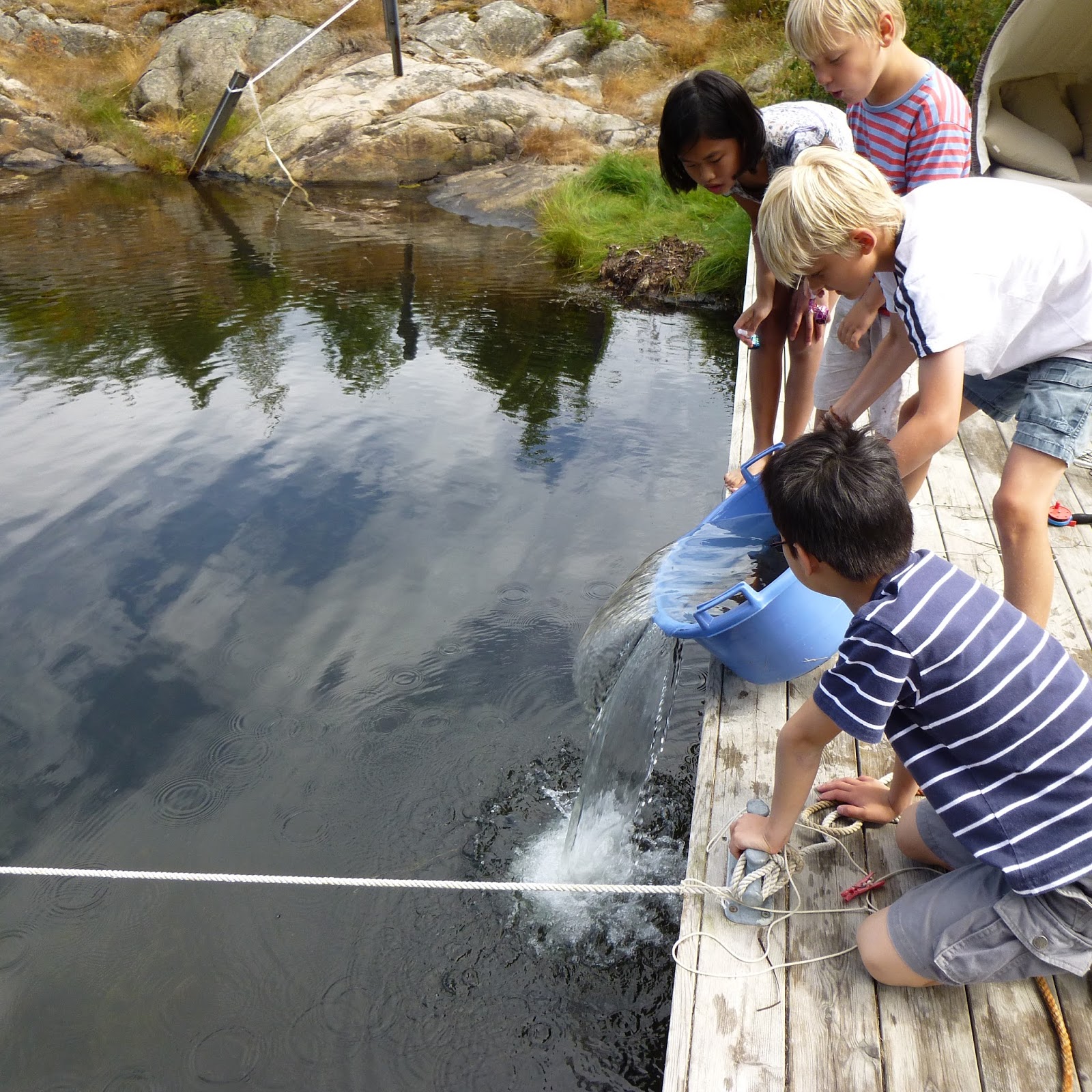
This past-time occupied the kids for the rest of the afternoon. The next day, they were at it again. We lacked a fish head but discovered that crabs also like pickled herring. When we ran out of that, Håkon and Øyvind showed the kids how to find mussels, smash them open with a rock and pick out the meat inside to bait the "hook." At one point, the kids sent Doug into the water for mussels. When this proved unsuccesful, Øvyind dove into the water and collected them by hand.


By the end of this fishing session, the kids had easily collected 25 crabs. They granted them all clemency.


 How could this visit to Arendal get any more special?

On our second morning there, we again had visitors to our beach. Here they are sailing in.


You can see that the lead swan has its wings raised. This is was a warning signal to us to keep away from his swanlets. You may also be able to see that his beak is open. This is because he was loudly hissing at us the whole time he was swimming right up to the dock. We take hissing swans VERY seriously and gave the swan family wide berth. They snacked (on what, I don't know) and after ten minutes, turned around and swam off.

Our last evening on the island, our hosts grilled fresh mackerel and potatoes for us. Dessert was fresh strawberries in heavy cream. Delicious. After dinner, they introduced us to the game of Kubb (pronounced like Koob), an ancient game perhaps played by the Vikings. The rules, while not complex, are too involved to go into here. The main idea, though, is that there are two sides. Each throws short wooden poles and tries to knock down the wooden blocks lined up in front of the other side. Here is a video of the kids. (They faced off against the grown ups.)


On our last day, more fishing and playing with Robin. I do not think I have ever seen Addie and Bram so utterly content. In the afternoon, we had a leisurely lunch at our hosts' cabin. We then walked to their beach, where the four kids were busy playing. Here's the view of their beach from up above.


 It was almost 5 p.m.; we had been in Arendal for just over 48 hours and it was time to say good bye. We got a lift to the bus station. Climbing aboard the bus, which in 4 1/2 hours, would deliver us back to Oslo, I felt as if we were leaving paradise behind.  I knew for a fact that we had when, 10 minutes into the trip, Addie turned to me and said "I think I'm going to be sick." Boy, was she ever right! Thank goodness for plastic bags.